
SoftwareentwicklungLogistics & Mobility
Multi-Tenant Address and Last-Mile Delivery Platform
An address-sharing and last-mile delivery SaaS platform for a Saudi startup: one API behind three web portals and two mobile apps.
Projektüberblick
A Saudi Arabian startup building address infrastructure for last-mile delivery, in a market where many street addresses are incomplete or ambiguous.
- Standort
- Saudi Arabia
- Team
- 6 people
Stack
- Backend
- .NET, ABP Framework, SQL Server
- Frontend
- Angular (web portals), Flutter (mobile apps)
- Data & AI
- Elasticsearch
- Infrastructure
- AWS EC2, AWS S3, nginx, Azure DevOps
- Integrations
- Twilio WhatsApp, SMTP email
Die Aufgabe und was sie gelöst hat
Geschäftliche Herausforderung
Couriers in the client's market often cannot find the door from a written address, so deliveries fail and drivers phone the customer for directions. Customers who shared a home address with a courier had no way to take that access back. Delivery companies ran driver onboarding, document expiry, vehicles and packages in separate tools. The client needed one platform for consumers, businesses, delivery companies and its own operators, sold as subscription SaaS.
Was wir gemacht haben
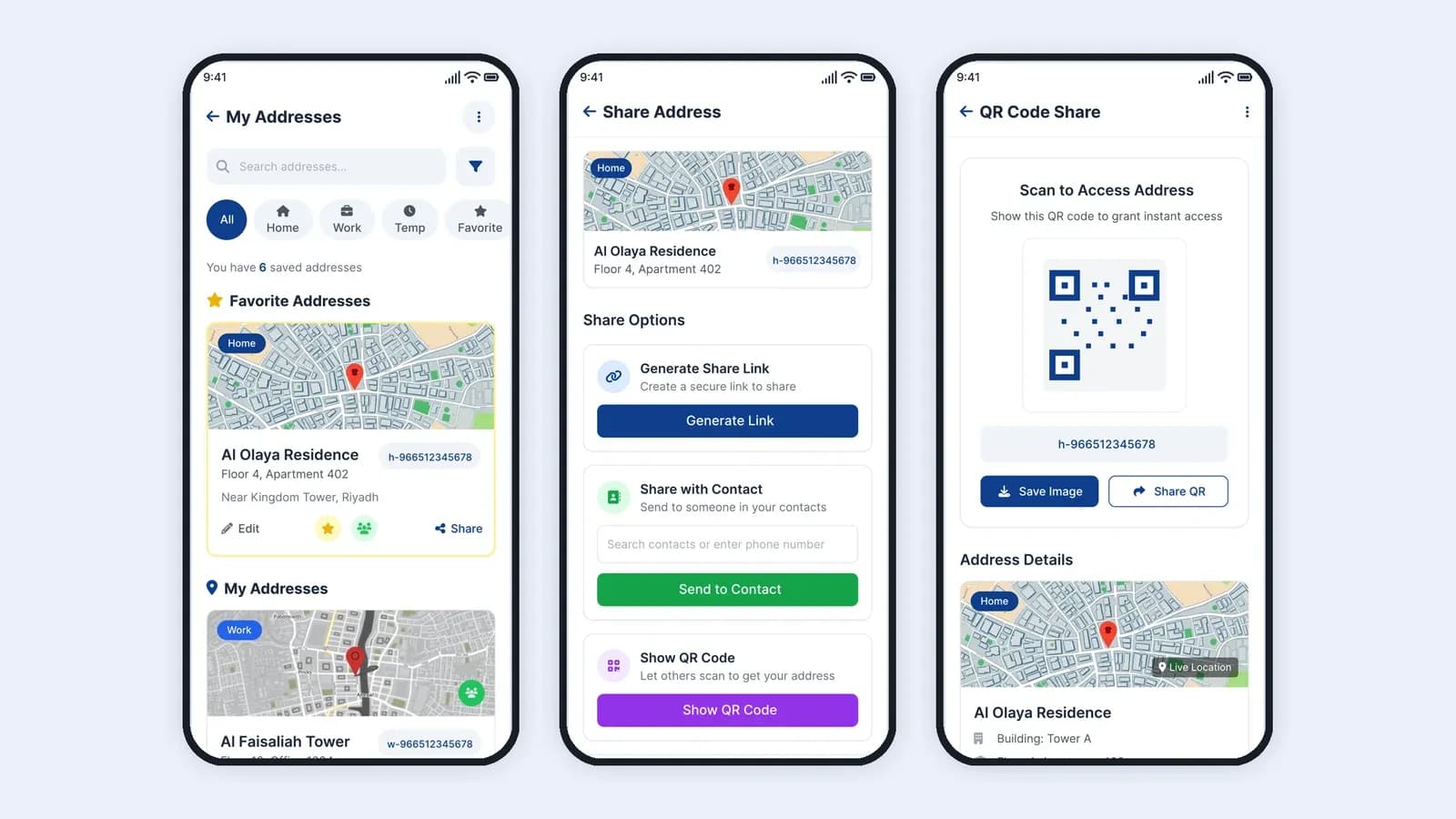
Every address gets a short ID derived from the owner's phone number and address type. It can be read out over the phone or shown as a QR code, and it resolves to an exact point plus access instructions. Owners decide who sees a private address: a courier gets a share link that expires, or submits an access request stating a purpose that the owner approves or rejects. Businesses keep one address book for head office, branches and temporary sites. Delivery companies onboard drivers, track document expiry and dispatch packages from one portal.
Technische Herausforderung
Five audiences had to share one backend while each organisation kept its own data and branding. Addresses had to be found by distance, not only by exact match. Sign-in had to work for users who only have a phone and no password. Sensitive data sent from the mobile apps needed protection on top of standard transport encryption.
Was wir gemacht haben
One API serves all five clients. Each organisation is a separate tenant with its own data, colours, logo, language, timezone and currency. Addresses are indexed for geo-distance search. Sign-in uses a one-time code sent over WhatsApp or email. Sensitive mobile payloads are encrypted end to end at the application layer.
Herausforderung in der Umsetzung
Six codebases (an API, three web portals and two mobile apps) had to move together, so a change to an address or delivery rule reached every client at once. Scope was held against an agreed feature list while the product design kept evolving, and the client ran its own QA rounds against the live build.
Was wir gemacht haben
We wrote the requirements, the source-code reference and a security control checklist alongside the build, and tracked every agreed line item against the code. Client QA findings were triaged item by item, fixed in each affected codebase and retested against the live environment.
Warum wir
We covered the full stack in one team: backend, web portals and both mobile apps, plus the geospatial search the address model depends on. The client got one accountable team instead of separate web, mobile and GIS vendors.
Ergebnisse
The client runs consumer, business, driver, delivery-company and operator workflows from one codebase and one data model, in English and Arabic with right-to-left layout.
Was wir geliefert haben
Phone-derived address IDs
A short, speakable identifier per address, also shown as a QR code, that resolves to a map point and access notes.
Revocable address sharing
Share links with their own expiry, plus a request-and-approve workflow for private addresses.
Geo-distance address search
Addresses found by distance, with public address discovery across organisations.
Delivery operations portal
Driver onboarding, document and vehicle records, bulk package import, driver assignment and dispatch routes.
Driver mobile app
Self-registration, online and offline status, today's deliveries, QR scanning and delivery status updates.
White-label tenants and operator console
Per-organisation branding and locale, subscription plans, organisation verification and platform administration.